


The income statement shows a profit, but by the end of the month, the bank balance is barely enough to cover wages, social security contributions, and payments to suppliers. That’s why anyone running an SME needs a few up-to-date reports that drive concrete decisions.
The annual financial statements come too late for decision-making
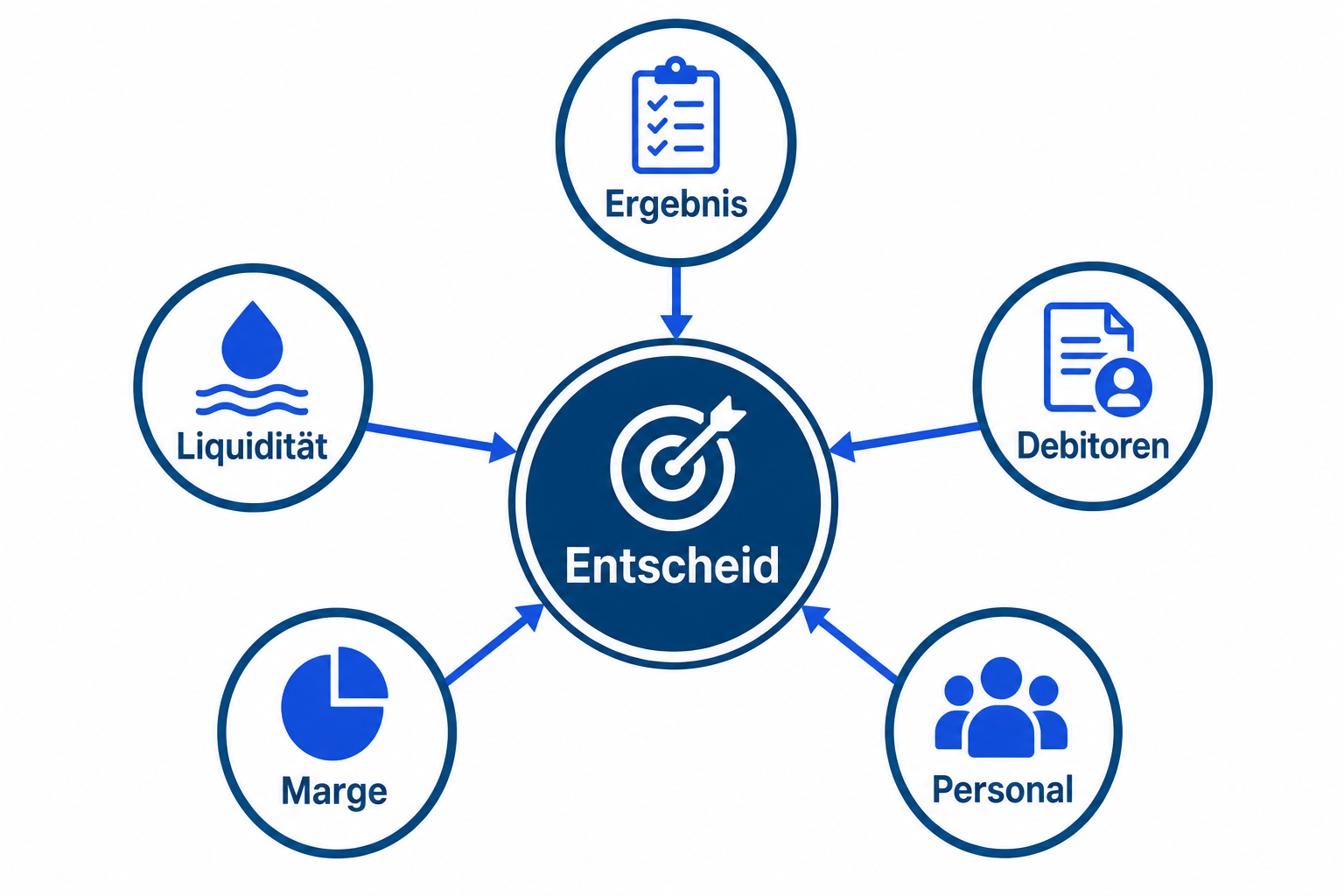
The statutory annual financial statements document a completed fiscal year. They do not show whether a project is profitable, which customers are late in paying, or when the account goes into the red. A management dashboard must therefore be based on current transaction data and budgeted figures. The audit requirement does not determine how rigorously a company should manage its internal controls. For a statutory audit, the thresholds in 2026 will be a balance sheet total of CHF 20 million, revenue of CHF 40 million, and 250 full-time equivalents. Two of these three thresholds must be exceeded in two consecutive fiscal years. These thresholds do not indicate what types of analyses a smaller SME may require.| Analysis | Key Question |
|---|---|
| Income Statement with Budget Comparison | Where do revenue, margin, and costs deviate from the plan? |
| Rolling Liquidity Planning | When Is a Funding Gap Likely to Occur? |
| Aged Receivables Report | Which invoices require specific collection action? |
| Contribution Margin by Segment | Which services and customers cover the fixed costs? |
| Labor Costs and Performance | Is staffing aligned with the work performed? |
Liquidity requires a forward-looking view rather than a snapshot
A high account balance at the end of the month can be misleading. Shortly thereafter, wages, sales tax, insurance premiums, or supplier invoices become due. Cash flow planning organizes expected inflows and outflows according to their actual payment dates. The federal government’s SME portal recommends updating this information monthly—or, better yet, weekly. Under Article 725 of the Swiss Code of Obligations, the board of directors must monitor the company’s solvency and act promptly if insolvency is imminent. A single balance sheet ratio is not sufficient for this purpose: it shows current balances but does not reveal impending payment peaks. Value-added tax (VAT) must also be factored into planning. Companies with annual sales of CHF 5,005,000 or less may, upon application, file annual returns in 2026. Under the actual method and the flat-rate method, installments are due on May 30, August 30, and November 30. The tax return must be filed and paid by the end of February of the following year.In short: The income statement explains the net income. Cash flow planning shows whether the company can meet its upcoming obligations on time.
The age of accounts receivable has a direct impact on the bank account
The total accounts receivable balance alone is not very informative. The aging schedule provides more meaningful insight: not yet due, up to 30 days past due, 31 to 60 days past due, and past due for longer than that. The accounts receivable target also shows how many days elapse between invoicing and payment. If this deadline is extended, management should do more than just review the accounts receivable process. Delays often arise earlier: employees enter services too late, invoices are awaiting approval, or customers dispute unclear line items. The federal government’s SME portal therefore recommends systematically monitoring invoicing and incoming payments.Example
The fictional company Meier Anlagenbau AG generates revenue of CHF 4,800,000, excluding VAT, in fiscal year 2026. Through faster invoicing and consistent follow-up, its average accounts receivable collection period decreases from 52 to 42 days. Per calendar day, revenue amounts to CHF 4,800,000 divided by 365, or approximately CHF 13,151. A 10-day reduction in accounts receivable days mathematically frees up approximately CHF 131,510 in liquidity. Revenue and profit remain unchanged for now, but the amount of available cash increases.
Revenue without contribution margin can make growth more expensive
A sales report rewards volume but does not reveal whether an order—after accounting for materials, outsourced services, transportation, discounts, and productive labor hours—still contributes to covering fixed costs. SMEs should analyze the contribution margin by product group, project, location, or customer group. The appropriate breakdown depends on the business model. When it comes to personnel costs, a ratio based on gross wages also falls short. A reliable calculation includes employer contributions, pension plans, accident insurance, family allowances, vacation and overtime pay, as well as agreed-upon bonuses. The employer’s share of AHV, IV, and EO contributions totals 5.3 percent of the relevant wage in 2026. Other costs vary by canton, insurance plan, age, and wage structure. Costs must be measured against a performance metric. In service-oriented businesses, billable hours or fee revenue are appropriate metrics; in manufacturing, they might include production hours, unit quantities, or contribution margins. A flat industry-wide figure only partially reflects the specific characteristics of an individual business.Few key performance indicators require clearly defined individuals responsible for them
A dashboard full of traffic lights doesn’t automatically provide leadership. Every metric needs a defined data source, a benchmark, a person in charge, and an agreed-upon response. Otherwise, management will end up discussing differing data points instead of taking action. Keeping track of current figures is time-consuming: projects must be segmented, inventory valued, and internal hours recorded in a timely manner. Furthermore, forecasts remain uncertain when payment dates or incoming orders fluctuate significantly. Small businesses without complex projects or inventories therefore do not need a sophisticated controlling system. Often, a monthly income statement, rolling cash flow planning, an up-to-date list of accounts receivable, and a few margin or performance metrics are sufficient. Consequence: Effective key performance indicators link earnings, liquidity, capital employed, margins, and workforce utilization to specific decisions. By regularly reviewing variances and assigning responsibilities, you can identify problems before the year-end financial statements are prepared. Meng & Partner helps small and medium-sized enterprises (SMEs) develop appropriate reports and reliably process their accounting data. The scope of services depends on the business model, organizational structure, and management needs.Sources
- https://www.kmu.admin.ch/de/kennzahlen-zur-unternehmensueberwachung
- https://www.fedlex.admin.ch/filestore/fedlex.data.admin.ch/eli/oc/2020/746/de/pdf-a/fedlex-data-admin-ch-eli-oc-2020-746-de-pdf-a.pdf
- https://www.estv.admin.ch/de/mwst-jaehrliche-abrechnung-2025
- https://www.estv.admin.ch/de/mwst-online-abrechnen
- https://www.ahv-iv.ch/p/2.01.d
- https://www.esa.admin.ch/de/revisionsrecht-or-und-hregv

