

The supplier invoice has been paid, but no one can find it. It’s in the project manager’s email inbox, in the accounting system, or saved as “Scan_0047.pdf” on the server. While three employees search for it, the accountant waits for the receipt.
More than just working hours are at stake. If there is no link between the invoice, approval, payment, and accounting entry, the company must reconstruct business transactions retroactively. In the event of a VAT audit, the audit trail must be traceable from the individual document to the settlement and back, as the Federal Tax Administration states.
A document management system works when each document has a unique storage location, controlled access, and mandatory retention and deletion periods.
The filing must follow the business transaction
Many small and medium-sized businesses structure their file system to reflect their organizational structure: management, administration, sales, and employees. This seems logical—until a customer order passes through multiple departments. Then the quote, contract, delivery slip, invoice, and correspondence end up scattered across different folders. A file should serve to organize the business transaction. For a customer order, the number “A-2026-0148” can link the quote, purchase order, fulfillment, acceptance, and invoice. The department remains an access criterion but does not determine the primary storage location. People’s names are also unsuitable as the top-level structure. Employees change roles or leave the company. Processes such as purchasing, sales, human resources, finance, and projects remain in place.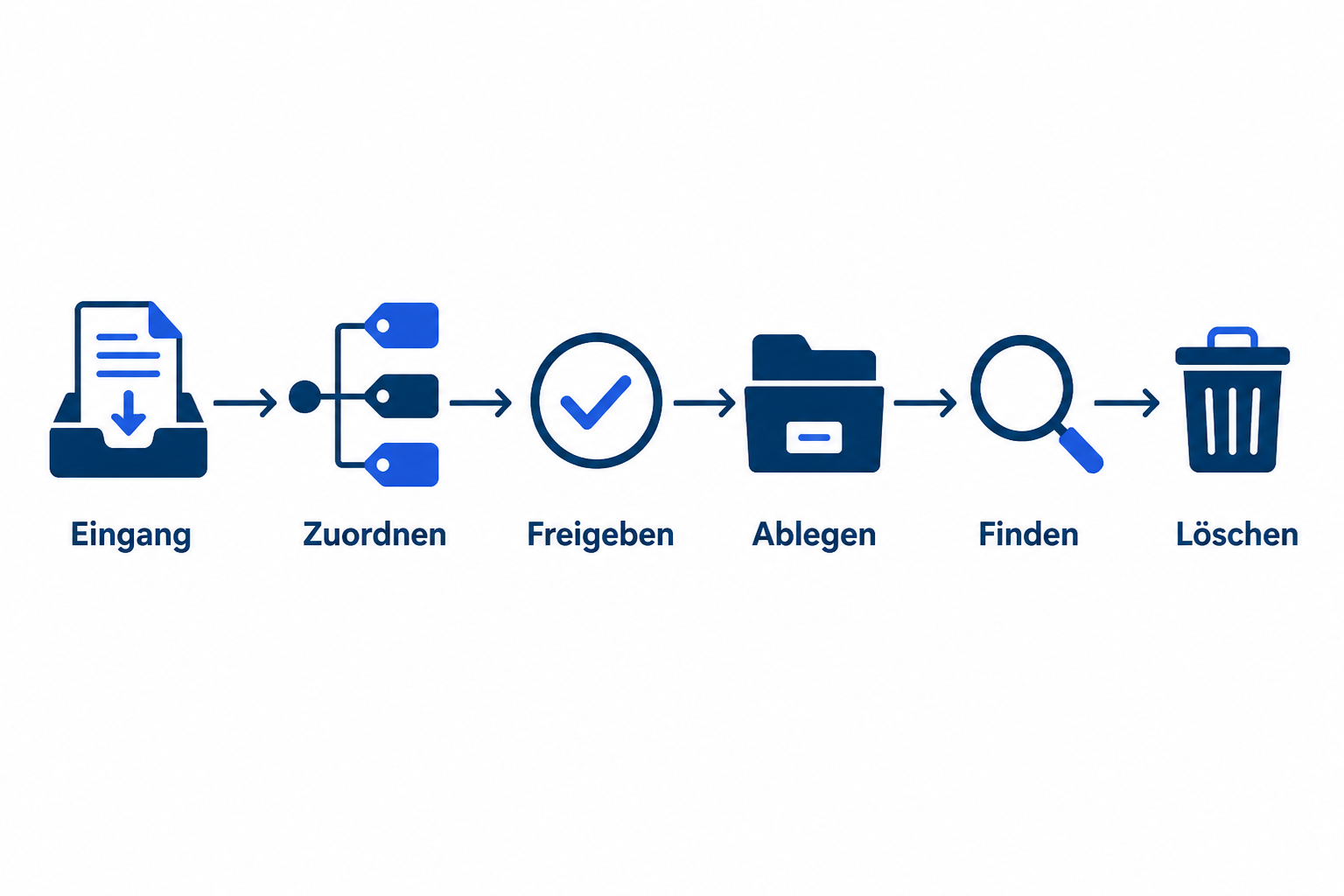
A good search starts before you save
A full-text search is of little help if scans are illegible or if files lack context. The system should capture five pieces of information when storing documents: document type, date, business partner, business transaction, and status. A few reliable fields are better than numerous fields that no one updates. Descriptive file names are still useful. “2026-04-18_MeierAG_Invoice_10482.pdf” can be easily identified even outside the system. “Scan_0047.pdf,” on the other hand, remains a mystery despite a quick search. Every document also needs a primary storage location. If the team sends copies via email and saves additional versions on personal drives, it becomes unclear later on which version is the current one. The dossier therefore contains the original; employees simply share a link to it.
The fictional company Huber Metallbau AG will employ a total of 28 people in 2026. Six employees in administration and project management collectively perform 15 document searches per workday. Before the reorganization, a search took an average of four minutes; afterward, it takes 45 seconds. This saves 48.75 minutes per day and, with 220 workdays, 178.75 hours per year.
With internal full costs of CHF 72 per hour, the annual time savings amount to CHF 12,870. The implementation costs a total of CHF 9,760 for 80 internal hours, plus setup and training. After ongoing costs of CHF 180 per month, the net benefit is CHF 892.50 per month. The investment pays for itself in about eleven months.
Just because something is stored digitally doesn’t mean it’s properly archived
In Switzerland, business records, accounting documents, and business and audit reports must be retained for ten years. The retention period begins at the end of the fiscal year, as explained by the federal government’s SME portal. A document from a fiscal year ending on December 31, 2026, must therefore be retained until the end of 2036. According to the Federal Tax Administration, business records related to real property that are relevant for VAT purposes must be retained for 20 years. These include, for example, records related to the exemption of contributions or to own-use. For the 2026 tax period, retention is therefore required until the end of 2046; a longer statutory statute of limitations extends this period. Electronic records must remain legible and traceable throughout the entire retention period. For modifiable storage media, procedures are required that identify changes, document the time of storage, and maintain logs. A suitable file format supports long-term readability but does not replace these controls. A common objection is: “Our cloud provider backs up everything, doesn’t it?” A backup protects against data loss, but it does not prove that the data has remained unchanged, nor does it confirm that it was properly authorized or retained for the required period. According to the Federal Data Protection and Information Commissioner, SMEs remain responsible for data protection even when an external provider processes data.First the filing rules, then the software
A new system does not resolve unclear lines of responsibility. Before making a selection, the SME should establish a simple filing policy for the most important types of documents. Start with invoices, contracts, personnel files, and key project documents.- Identify business transactions and unique case numbers
- Specify a primary storage location for each document type
- Define five required search criteria
- Grant Access Based on Roles Rather Than Individuals
- Set Retention and Deletion Periods
- Log Changes, Approvals, and Deletions
- Check Readability and Recovery Using Samples
Sources
- https://www.kmu.admin.ch/de/elektronische-aufbewahrung-der-geschaeftsbuecher
- https://www.kmu.admin.ch/de/buchhaltungspflicht-fuer-handelsgesellschaften
- https://www.estv.admin.ch/de/mwst-kontrolle
- https://www.estv.admin.ch/dam/de/sd-web/sc4WgPZIIElS/21019-mwstg-mit-aenderungen-de.pdf
- https://www.edoeb.admin.ch/de/faq-datenschutz
- https://www.edoeb.admin.ch/de/outsourcing-auftragsdatenbearbeitung
- https://www.edoeb.admin.ch/de/datenbearbeitungen-in-der-cloud

