


Revenue without profit margin is not a success story
The monthly income statement serves as the starting point. Revenue and earnings should be compared to the budget and the previous year—both for the individual month and on a cumulative basis since the beginning of the year. A monthly figure may be skewed by vacations, large orders, or delayed invoices. In addition to revenue, management needs to track gross profit or contribution margin, personnel expenses, and operating income. The appropriate level of detail depends on the business model: A retail business monitors cost of goods sold, a consulting firm tracks billable services, and a manufacturing company monitors material, machinery, and production costs. The margin as a percentage of revenue is particularly revealing. If revenue increases while the margin decreases, discounts, higher purchase prices, or an unfavorable product mix may be eating into the additional revenue. The causes only become apparent when the accounting department breaks down revenue and direct costs by product group, order, or division.In short: A management analysis shows not only whether revenue is increasing, but also whether the additional business is actually turning a profit.
Liquidity should take precedence over annual profit
Even a profitable company can become insolvent. Under Art. 725 of the Swiss Code of Obligations (OR), the board of directors must monitor the company’s solvency and act with due urgency in the event of impending cash flow problems. A continuously updated liquidity plan is therefore an integral part of financial management. The budget compares expected cash inflows and outflows with available bank balances and credit limits. It includes salaries, supplier payments, investments, loan payments, social security contributions, and taxes. Confirmed orders do not yet constitute cash inflows. What matters is when the invoice is issued and when payment is expected. The accounts receivable aging report complements this planning. It categorizes outstanding invoices by due date and highlights individual overdue items. The DSO metric also shows how long revenue remains tied up in accounts receivable on average. According to the 2021 SECO study on the financing of Swiss SMEs, trade receivables accounted for an average of about one-fifth of total assets among the companies surveyed. Faster collection can therefore free up a significant amount of liquidity.Example
The fictional company Aargau Präzision GmbH generates annual revenue of CHF 6,000,000 on an invoice basis in 2026. Its average accounts receivable amount to CHF 780,000. This results in 47.5 days of accounts receivable: CHF 780,000 divided by CHF 6,000,000, multiplied by 365. Through faster invoicing and consistent follow-up on overdue payments, this figure drops to 38 days. The tied-up receivables are reduced to approximately CHF 625,000. This frees up about CHF 155,000 in liquidity—without additional revenue or a bank loan.
Taxes should be included in the payment schedule
The account balance can be misleading if reserved amounts are not shown separately. Collected value-added tax, employee deductions, and payments on account are not freely available cash. If the annual wage subject to AHV contributions exceeds CHF 200,000, employers must pay the contributions monthly. The amount must be received by the compensation office no later than the tenth day after the end of the month. According to the AHV/IV Information Center, late payments are subject to a 5 percent annual late payment penalty. Starting with the 2025 tax period, companies with annual revenue of up to CHF 5,005,000 may, under certain conditions, file their VAT returns on an annual basis. Under the actual method and the flat-rate method, the Federal Tax Administration sets three installments due on May 30, August 30, and November 30. The annual return is due by the end of February of the following year. For the 2026 tax period, the application deadline was February 28, 2026; newly taxable businesses have 60 days after receiving their VAT number. As of January 1, 2026, the interest rate on late payments for federal taxes and levies is generally 4 percent instead of 4.5 percent. This applies, among other things, to value-added tax and federal direct tax. However, this reduction does not make late payments a viable source of financing.Few key performance indicators require clearly defined individuals responsible for them
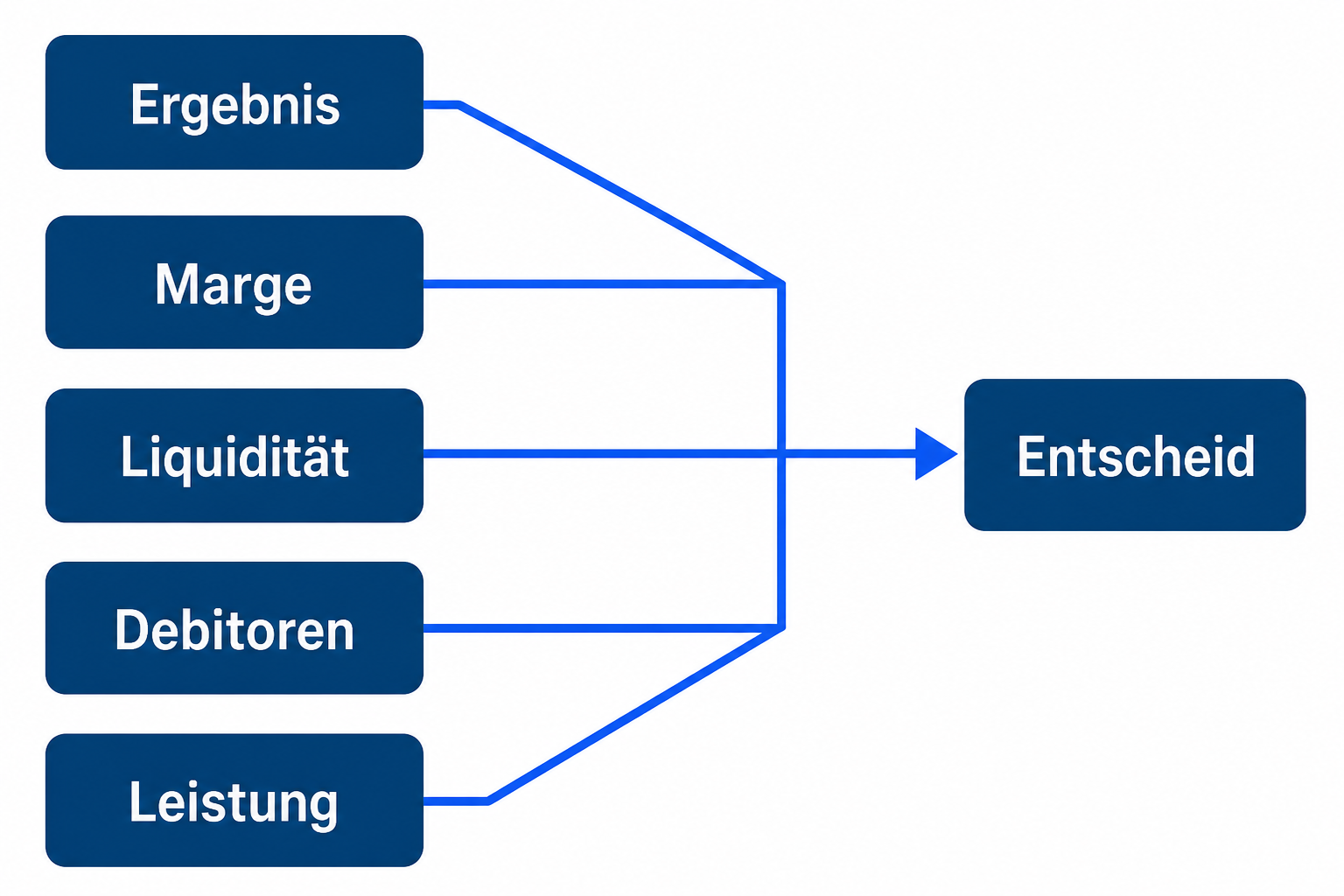
A cluttered dashboard rarely provides clarity. Every metric needs a key question, a transparent data source, and a designated person who can explain deviations and propose actions.| Analysis | Key Question |
|---|---|
| Income Statement with Comparison | Where do revenue, margin, or cost variances occur? |
| Liquidity Planning | Are bank balances and credit limits sufficient to cover upcoming payments? |
| Aging of Accounts Receivable | Which invoices are tying up cash flow? |
| Contribution Margins | Which orders, products, or divisions are profitable? |
| Operational Performance Drivers | What development will next impact the financial results? |
Deviations Must Lead to Decisions
SMEs need a monthly income statement, an up-to-date cash flow forecast, an accounts receivable analysis, and a few key metrics on margins and performance. The crucial factor is what action a deviation triggers. Meng & Partner helps small and medium-sized businesses develop meaningful financial analyses and coordinate their accounting, budgeting, and cash flow planning. This provides management with the financial data they need to make informed decisions.Sources
- https://www.seco.admin.ch/dam/seco/en/dokumente/Standortfoerderung/KMU-Politik/Finanzierung%20der%20KMU/studie_zur_finanzierung_der_kmu_in_der_schweiz_2021.pdf.download.pdf/Studie_KMU_SECO_2021_de.pdf
- https://www.fedlex.admin.ch/filestore/fedlex.data.admin.ch/eli/oc/2020/746/de/pdf-a/fedlex-data-admin-ch-eli-oc-2020-746-de-pdf-a.pdf
- https://www.ahv-iv.ch/p/2.01.d
- https://www.estv.admin.ch/de/mwst-jaehrliche-abrechnung-2025
- https://www.estv.admin.ch/de/newnsb/YzhHMdd4LZ4LzVJZog9cO
- https://www.estv.admin.ch/de/newnsb/58uetWbVftSvrQqxHgivI

